
















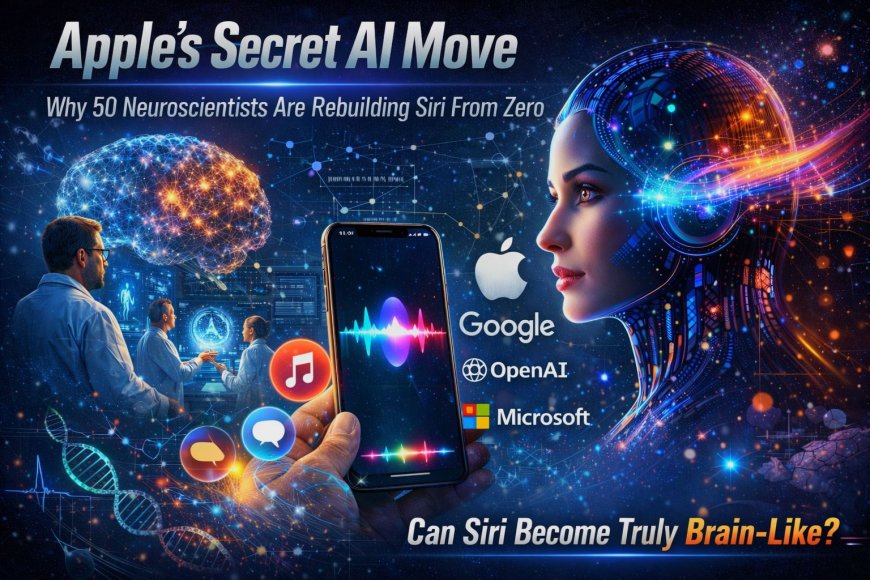
🧠 Apple’s Secret AI Move: Why 50 Neuroscientists Are Rebuilding Siri From Zero
That’s exactly the direction Apple Inc. seems to be heading. In a move that’s raising eyebrows across Silicon Valley, Apple has reportedly hired around 50 neuroscientists to completely reimagine Siri — not as a voice assistant, but as something far more intelligent, adaptive, and human-like.

What if your phone didnt just respond but actuallyunderstood you like a human brain?
Thats exactly the direction Apple Inc. seems to be heading. In a move thats raising eyebrows across Silicon Valley, Apple has reportedly hired around 50 neuroscientists to completely reimagine Siri not as a voice assistant, but as something far more intelligent, adaptive, and human-like.
And this isnt just another update. This is a full reset.
? Why Apple Is Starting Over
Lets be honest while Siri was once revolutionary, it hasnt aged well. Compared to modern AI systems like ChatGPT or Googles latest models, Siri often feels limited.
It struggles with context. It forgets previous commands. It doesnt think it reacts.
Apple knows this.
Instead of patching old systems, theyve decided to rebuild Siri from the ground up using insights from neuroscience the science of how the human brain actually works.
? The Big Idea: AI That Thinks Like You
Traditional AI models rely heavily on data and pattern recognition. But Apples new approach goes deeper.
By hiring neuroscientists, theyre trying to replicate how humans:
- Learn from experience
- Understand context over time
- Make decisions with incomplete information
- Adapt dynamically to new situations
In short, Apple wants Siri to behave less like a command tool and more like a cognitive partner.
Imagine telling Siri something once and it remembers, learns your preferences, and improves without being retrained.
Thats not just AI. Thats brain-inspired intelligence.
? From Assistant to Digital Mind
The goal isnt just to make Siri smarter its to make it aware (not conscious, but contextually intelligent).
Future Siri could:
- Hold natural, flowing conversations
- Understand emotions in your voice
- Predict what you need before you ask
- Learn your habits without constant prompts
This puts Apple in direct competition with companies like Google, OpenAI, and Microsoft all racing to build the most advanced AI assistant.
But Apples edge? Hardware + privacy + neuroscience.
? Privacy Meets Intelligence
Unlike many AI companies, Apple has always leaned heavily into on-device processing and privacy.
So instead of sending all your data to the cloud, the new Siri could:
- Learn directly from your device
- Keep personal data private
- Still deliver highly personalized responses
This could be a game-changer combining powerful AI with Apples strong privacy stance.
? Why This Matters More Than You Think
This isnt just about Siri.
This is about the future of human-computer interaction.
If Apple succeeds, your phone could become:
- A personal strategist
- A productivity partner
- A digital extension of your brain
Were moving from tools ? to intelligence companions.
And Apple doesnt usually enter a race unless it plans to win it.
? The Bigger Trend: Brain-Inspired AI
Apple isnt alone in this shift.
Across the AI world, researchers are moving toward neuromorphic computing systems designed to mimic neural structures of the brain.
This approach could unlock:
- Faster learning with less data
- Better decision-making
- More energy-efficient AI systems
But Apple bringing this into consumer tech? Thats what makes this moment huge.
? What Happens Next?
We likely wont see this new Siri overnight.
But expect:
- Major AI upgrades in upcoming iOS versions
- Smarter contextual responses
- More natural conversations
- Deep integration across Apple devices
And eventually a Siri that doesnt just assist it understands.
? Heres the Big Question for You:
If your phone could truly think and understand you would you trust it with your daily decisions?